 中文版
中文版 English

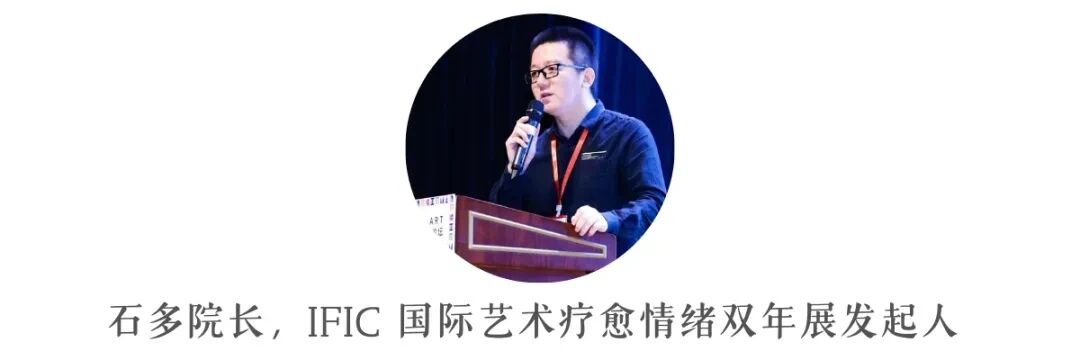
bigHello, my name is Shi Duo and I graduated from the School of Fine Arts at Tsinghua University. For many years, we have been committed to exploring the deeper power of art and have established an art university without walls, providing online services to over one million students. After the epidemic, I proposed the concept of "Art Healing Curator" and also initiated the "International Art Healing Emotional Biennial Exhibition". Today, I would like to have a sincere conversation with everyone about why I believe that closely integrating "art healing" with "curatorial thinking" is crucial for us, this industry, and even the entire society today.
I firmly believe in the value of art therapy. It is like a non-verbal window that allows people to release, perceive, repair, and connect. I have seen too many people find outlets and gain strength in their creations. However, I also clearly see the limitations of its current development in China: those precious healing moments often occur in the healing behavior of a few individuals, and a therapist can only serve extremely limited visitors at a time, like scattered pearls. Its radiance and universal significance behind it are difficult for the wider public to truly see, understand, and resonate. Although it has power, it is difficult to converge into a river.
This is the original intention behind my proposal and implementation of the "Art Healing Curator" - to use curatorial thinking and methods to systematically release, transform, and amplify the energy of art healing, allowing it to move from individual to public, from private to resonant, and from implicit to explicit. This is not only a display, but also a construction of a public healing.
This is how I understand and practice this combination:
Empowering Stories and Building Public Issues
The core of curation lies in narrative. I am not just displaying a painting or sculpture, but weaving a story. I weave art healing practices from different individuals and groups - creative processes, emotional traces, healing witnesses, etc. - into a public narrative with depth and breadth. I place them in social emotional maps such as' Trauma and Resilience in the Age of Anxiety 'and' Voices of Marginalized Groups'. I hope the audience can see not only the story of 'him/her', but also the shared experiences and possibilities of 'us'. Make art healing no longer just a case study, but a public issue that can be seen, discussed, and understood by society.
Creating an immersive field, from 'seeing' to 'being'
Traditional exhibitions are about 'seeing', while the core of our art healing exhibitions is' experiencing 'and' being present '. I will think about the use of space, such as how to use light, color, sound, and flow to create a "healing container" that makes people willing to take off their guard and stay at ease. I not only showcase the final work, but also present sketches, notes, images of the creative process, and even set up interactive areas that can be touched, written, and co created, incorporating small guiding experiences. I hope the audience comes in, not bystanders, but participants. The design of spatial sequences is like a carefully guided emotional journey, perhaps from repression to release, ultimately leading to hope and connection. I want space itself to become a catalyst for healing to occur.
Rooted in professionalism, establish credibility
I am well aware that art therapy is often questioned for its' effectiveness' and 'professionalism'. Curatorial thinking requires rigor, so IFIC and I have maintained in-depth discussions and collaborations with psychologists, neurologists, and doctors in the past two years. In the exhibition, I will clearly present the theoretical basis, working methods, ethical principles, as well as related research results and case studies of art therapy. This is not for the sake of advertising, but to let the public and professionals understand the power of art as a healing medium that is traceable and trustworthy. Transparency and academic support are the cornerstones for art healing to move towards a broader field.
Breaking the Silence, Popularizing Awareness
This may be a strong desire deep within my heart. The issue of mental health is still stigmatized, and many people avoid discussing it. Art has a natural affinity and penetrating power, and my curatorial practice is to use art as the 'soft key' to open the door to public understanding of emotions and psychology. Through exhibitions, visually demonstrate how art affects the body and mind, and how it becomes a daily tool for self-care, emotional regulation, and social connection. I hope exhibitions can become warm educational venues, lower the threshold for people to seek help, and make "mental health" no longer a cold label, but a daily topic that can be understood and discussed.
Connecting communities and catalyzing collective healing
The charm of exhibitions lies in their convergence. When creators involved in art healing see their stories respected and presented in public spaces, they gain a great sense of identity and value, which is itself a form of healing. And when the audience sees the vulnerability and strength of others, they resonate and realize that 'I am not alone', which invisibly constructs a support network based on empathy. The exhibition site often serves as a hub connecting artists, therapists, communities, and institutions. I look forward to it inspiring more offline healing projects, mutual aid groups, or social support actions to sustain the development of these connections.
Promote paradigm innovation and build the future of the industry
Launching the "International Art Healing Emotional Biennial Exhibition" is my deep practice of the concept of "Art Healing Curator". I firmly believe that this is a new composite role that requires us not only to understand art history and curation, but also to be proficient in psychology and healing, possess keen insight into social issues, and strong resource integration abilities. This expands the boundaries of curation and elevates the professional level of art healing. The biennial exhibition gathers global wisdom, promotes cross-cultural dialogue and cooperation, and jointly explores evaluation standards and ethical norms. We are promoting the formation of paradigms in emerging interdisciplinary fields, stimulating market demand, cultivating more versatile talents, and laying a solid foundation for industry development.
In summary, what is the significance of this combination for the present?
For the art world, it brings art back to its most authentic emotional and spiritual power, expands the boundaries and social functions of art, and opens up a new path for institutions such as art museums with a greater sense of social responsibility and participation.
For the field of mental health, it provides an innovative, non clinical, and low threshold prevention and auxiliary intervention method, enriches the mental health service system, and truly enables the integration model of "mind body society" to be implemented.
For the general public, it provides a new perspective and tool to understand their own emotions and cope with the pressures of the times, enhances the mental health literacy of the entire population, and helps to create a more empathetic and supportive social environment.
For the development of disciplines, it has built an excellent practical field, deeply integrating multiple disciplines such as art, design, psychology, medicine, and society, and giving birth to new knowledge growth points.
Finally, I would like to say that my proposal and practice of "Art Healing Curation" is aimed at building a crucial bridge. Gather, transform, and amplify the healing light scattered in the depths of individuals and corners of workshops through systematic, public, narrative, and experiential design curation, illuminating more people. This is a tribute to every unique life story, and also a deep concern and positive response to the collective emotional health of our era. I believe that curation can go beyond mere display and become a powerful healing vessel and public action. This road is still long, but I am willing to continue exploring with my fellow travelers, using the power of art to light warm and firm lamps in this challenging era, illuminating both myself and others.